

The debate between Dubai real estate investment and London property investment has grown sharper in recent years, as global investors seek safer, more rewarding markets amid economic uncertainty. While both cities are considered global financial hubs and property magnets, their real estate landscapes, returns, and long-term investment potential couldn’t be more different.
In this article, we’ll explore whether Dubai real estate investment truly offers higher profitability than London, analyzing market performance, rental yields, taxes, investor sentiment, and projected growth.
The Global Appeal of Two Giants: Dubai vs. London
Both Dubai and London attract international investors for their stability, infrastructure, and lifestyle appeal. Yet, their market fundamentals differ in nearly every respect.
- London is known for its heritage, regulatory stability, and reputation as a global financial center. Its luxury properties have long served as safe-haven assets for wealthy investors.
- Dubai, on the other hand, has rapidly transformed into a futuristic real estate hub offering high yields, zero property tax, and strong government-backed growth incentives.
These contrasting advantages mean investors must define their goals: are they seeking long-term asset security or higher immediate returns?
Profitability Analysis: Rental Yields Speak Loudest
When evaluating potential profit, rental returns are one of the clearest indicators. Over the past five years, Dubai’s property yields have considerably outperformed London’s average.
- Dubai average rental yield: between 6% to 9%, depending on the location (e.g., Business Bay, Jumeirah Village Circle, or Marina).
- London average rental yield: typically between 3% to 4%, with central London often yielding less due to high entry prices.
This yield gap makes Dubai significantly more attractive to investors seeking stronger cash flow. A one-bedroom apartment in Dubai Marina or Downtown can bring nearly double the return of a similar property in central London.
Moreover, Dubai’s short-term rental market—especially through platforms like Airbnb—is thriving due to consistent tourism and year-round demand, further boosting investor profits.
Tax-Free Advantage: One of Dubai’s Strongest Edges
Taxes can dramatically influence net profitability. London real estate is subject to several taxes, including capital gains, stamp duty, income tax on rental earnings, and council taxes. For international investors, these obligations often reduce profitability unless the holding is long-term.
In contrast, Dubai real estate investment enjoys a fully tax-free environment on property income and capital gains. There is no annual property tax, no inheritance tax, and no stamp duty on purchase or sale transactions.
This alone is a decisive factor for global investors, especially those seeking maximum return with minimal bureaucratic overhead. The tax-free structure is one of Dubai’s most compelling features and a major reason behind the city’s consistent inflow of capital from Europe, Asia, and the Americas.
Market Accessibility and Entry Costs
Dubai’s real estate market is comparatively more accessible than London’s, both in terms of entry price and transaction process.
- In Dubai, modern studio apartments start around AED 700,000 to AED 1 million (approximately GBP 150,000–220,000), giving first-time investors a lower entry barrier.
- In London, even modest apartments can range from GBP 450,000 upwards, especially within Zone 1 or 2.
This affordability makes Dubai real estate investment attractive not only to high-net-worth individuals but also to young professionals and mid-range investors seeking international exposure without heavy capital commitment.
Additionally, Dubai’s digital-first ecosystem simplifies ownership. Buying a property can be completed in days, with secure registration under the Dubai Land Department (DLD) and investor protection guaranteed through the Real Estate Regulatory Agency (RERA).
Economic Climate and Stability
London’s real estate market faced growing uncertainty post-Brexit, affecting investor confidence and growth rates. Rising taxes on overseas buyers and currency fluctuations have added further pressure on profitability margins.
Dubai’s opposite trajectory is impressive. Over the past decade, the Emirate has positioned itself as a global business hub built on strategic policies and free zones that attract foreign investors. Mega-events such as Expo 2020, followed by ongoing developments like Dubai 2040 Urban Master Plan, have stimulated property value appreciation year over year.
Dubai’s economy is diversified, powered by tourism, technology, and finance—not just oil—ensuring continued real estate demand and resilience. Even during global slowdowns, Dubai’s property market has demonstrated agility and recovery speed that often outpaces London’s.
Comparative ROI Trends
Looking at the return on investment (ROI) over the past few years provides an even clearer perspective:
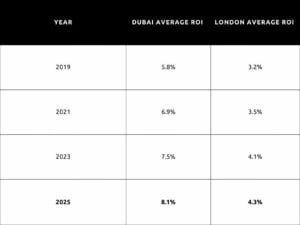
The consistent upward curve in Dubai’s ROI reveals a market fueled by sustainable development, increased foreign ownership flexibility, and strategic visa programs that connect property ownership with long-term residency.
Residency and Visa Benefits
Dubai offers unmatched advantages for investors through its Golden Visa and Property Investor Visa programs. With a real estate investment of AED 2 million or more, investors can secure renewable 10-year residency, extendable to family members.
London offers no direct residency or citizenship benefits through property investment. The former Tier 1 Investor Visa has been discontinued, reducing London’s appeal for global investors seeking both returns and residency privileges.
This unique combination of profit and lifestyle opportunity gives Dubai real estate investment a significant edge over London’s more restrictive immigration framework.
Government Support and Visionary Planning
The Dubai government’s proactive approach continues to uplift real estate performance. Initiatives like Dubai 2040 Urban Master Plan, liberalized business laws, extended property ownership rights for foreigners, and the expansion of new communities such as Dubai Creek Harbour, Mohammed Bin Rashid City, and Dubai South show clear evidence of forward-thinking development.
London’s growth, while stable, remains slower and more limited due to infrastructural saturation and regulatory complexities. Planning permissions and construction costs often extend project timelines, affecting investor timelines and returns.
Dubai’s property development, meanwhile, benefits from swift approvals, world-class infrastructure, and an ever-evolving skyline that responds rapidly to market demand.
Lifestyle and Investor Appeal
Both cities offer unmatched allure but cater to different lifestyles.
- London thrives on culture, history, and education—appealing to long-term residents or those seeking stability within the European market.
- Dubai shines with luxury living, beachfront skyscrapers, global connectivity, and tax-free earnings—appealing to those drawn to growth, modernity, and year-round sunshine.
The UAE’s cosmopolitan environment and business-friendly climate attract expatriates and entrepreneurs alike, ensuring consistent housing demand that supports sustainable rental income.
Market Liquidity and Exit Potential
Liquidity—the ability to sell a property quickly without major value loss—is another measure of profitability.
Dubai has made major strides in improving liquidity. New digital transaction systems, high investor demand, and increasing international participation have made properties easier to sell—especially in areas like Downtown, Dubai Hills, or Dubai Marina. Developers are also offering attractive payment plans and post-handover options, enhancing resale potential.
In contrast, London’s resale process remains slower and costlier, with higher agent fees, legal costs, and tax implications that reduce net gain.
Risks to Consider
No market is without risk. While Dubai’s high yields and low taxes are appealing, investors should consider:
- Over-supply risks in certain districts.
- Potential interest rate fluctuations affecting mortgage payments.
- Currency conversion exposure when repatriating earnings.
Likewise, London investors face risks from regulations, rising interest rates, and slower market growth. However, both markets remain fundamentally solid long-term, supported by international investor confidence.
Smart investors typically diversify across both cities—leveraging Dubai for returns and London for capital preservation.
Future Outlook: What 2026 and Beyond Holds
Looking ahead, Dubai’s real estate investment landscape is positioned for robust expansion. Government-backed projects, technological integration (like AI-driven property management), and sustainable city planning promise continued growth.
London’s outlook is expected to remain stable but less dynamic. Its property values grow slowly, often tied to economic cycles rather than innovation-driven expansion.
For investors focusing on profitability, tax efficiency, and market momentum, Dubai remains the stronger contender as we move through 2026 and beyond.
The Verdict: Dubai Outshines London in Profitability
When comparing Dubai real estate investment with London property, the numbers and advantages are clear. Dubai simply delivers higher rental yields, better tax benefits, easier entry access, and residency options that combine financial reward with lifestyle appeal.
While London retains its timeless reputation as a global safe haven, its lower yields, higher taxes, and rising costs make it less attractive from a profitability standpoint.
In contrast, Dubai’s investor-focused policies, booming economy, and global accessibility cement its position as one of the world’s most profitable real estate markets in 2026.