
The Dubai Metro has long been more than just a transportation project—it’s a powerful engine driving the growth, accessibility, and transformation of Dubai real estate investment. Since its launch in 2009, the Metro has not only eased urban mobility but also redefined how investors and developers view property value across the city.
As Dubai expands into new areas and connects old ones with modern infrastructure, the Metro continues to play a critical role in shaping where people live, work, and invest. In this blog, we’ll explore how the Dubai Metro is influencing real estate dynamics, the areas seeing the biggest growth, and what investors can learn from this ongoing transport-led transformation.
The Link Between Transportation and Real Estate Growth
Globally, transportation infrastructure has always influenced property values. Easy connectivity translates into better quality of life, stronger rental demand, and higher property appreciation. Dubai is no exception.
When the Metro was inaugurated, many skeptics doubted whether a city so car-dependent would truly rely on rail transit. But today, the Dubai Metro stands as one of the most efficient, clean, and widely used public transportation systems in the world, covering over 90 kilometers across the city.
This connectivity revolution has turned proximity to Metro stations into a golden metric for Dubai real estate investment. Locations within walking distance of a Metro station routinely command higher property prices, stronger rental yields, and faster sale turnover than properties farther away.
The Economic Ripple Effect of the Metro
The Metro’s expansion has amplified development in both mature and emerging neighborhoods. The “ripple effect” of improved accessibility extends far beyond convenience—it breeds economic opportunity.
Developers strategically plan residential and commercial projects along Metro lines, recognizing that tenants and investors alike prioritize easy commutes. For residents, the Metro offers affordability and convenience; for investors, it guarantees continuous demand.
In recent years, properties near major Metro stations such as Dubai Marina, Business Bay, and Deira City Centre have consistently performed better in terms of price appreciation and occupancy rates. The introduction of the Route 2020 extension, connecting the Red Line to Expo City, has also opened new avenues for Dubai real estate investment in previously undervalued areas.
Key Metro-Connected Areas Boosting Property Value
Let’s break down some of the major zones where the Metro’s influence on real estate is most evident:
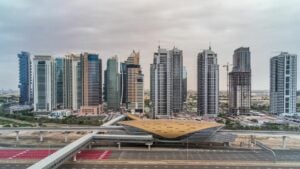
1. Dubai Marina
With direct access to the Red Line, Dubai Marina epitomizes the synergy between transport and lifestyle. The area offers seamless connectivity to key destinations like Downtown Dubai and Expo City, enhancing its attraction for both residents and short-term renters.
Apartments near Dubai Marina Metro Station often record higher rental yields, appealing to professionals who work in nearby business districts.
2. Business Bay
Business Bay’s strategic position along the Metro line has accelerated its transformation into one of Dubai’s top investment hotspots. Proximity to the Metro adds unmatched accessibility to Downtown Dubai and DIFC, making it a preferred choice for corporate tenants and entrepreneurs.
Many mid-range investors choose Business Bay because it balances luxury, location, and transport convenience—all essential factors driving solid Dubai real estate investment returns.
3. Al Jaddaf and Creekside Developments
Areas like Al Jaddaf, once considered secondary zones, now benefit from excellent Metro connectivity. The easy access to healthcare hubs, schools, and leisure destinations has spurred a steady rise in both property value and buyer interest.
4. Expo City and Dubai South
The extension to Expo 2020 and Dubai South marked a historic leap in urban development. The new Metro stations have redefined the region’s accessibility, transforming it into a high-potential investment area. As Dubai South evolves into an aviation, logistics, and innovation hub, investors foresee long-term capital appreciation supported by infrastructure and employment growth.
Metro-Driven Investment Trends
Transportation-oriented development has shaped a clear set of investment patterns in Dubai’s modern property market:
-
Increased demand for mid-market homes: The Metro provides cost-effective mobility, attracting a diverse range of tenants—especially professionals seeking affordable housing with easy access to workplaces.
-
Higher ROI for rental properties near stations: Properties within 500 to 800 meters of a Metro station typically command 10–20% higher rents compared to those farther away.
-
Rising value of commercial real estate: Businesses thrive on footfall and accessibility, and offices close to Metro lines often see higher occupancy and tenant retention rates.
-
Growth in short-term rentals: With the surge of tourism and business travel, Metro-connected locations have become prime spots for Airbnb-style short stays.
These patterns make it clear: the Dubai Metro has effectively reshaped the investment map of the emirate, directing developer interest and investor focus toward well-connected zones.
Sustainability and Mobility as Investment Catalysts
One of the most remarkable aspects of Dubai’s growth is its emphasis on future-oriented development. The Metro has become a cornerstone of Dubai’s sustainability agenda by reducing traffic congestion, lowering emissions, and promoting eco-friendly commuting habits.
For investors, sustainability isn’t just a buzzword—it’s a key value driver. Properties aligned with green mobility infrastructure tend to appeal more to environmentally conscious tenants and multinational firms seeking eco-certified spaces.
This alignment enhances long-term stability in Dubai real estate investment, positioning the city as a global model for sustainable urban growth.
The Upcoming Expansions and Their Real Estate Potential
Dubai isn’t done building. Plans for further Metro extensions—connecting new growth corridors and residential communities—promise another wave of investment opportunities.
Future expansion zones such as Dubai Creek Harbour, Meydan, and Jumeirah Village Circle (JVC) are already seeing interest from developers eager to capitalize on anticipated Metro connectivity. Each new line or extension doesn’t just bring transportation—it activates a fresh real estate micro-market.
These development forecasts align with Dubai’s long-term vision to accommodate population growth while maintaining a world-class quality of life through smart mobility planning.
How the Metro Strengthens Investor Confidence
Accessibility reduces risk. When an investor looks at a property near the Metro, they’re essentially buying liquidity—both in terms of rental potential and resale flexibility. The reduced reliance on cars and the promise of easy citywide mobility create a resilient investment case.
Additionally, continued government investment in infrastructure reassures international investors about Dubai’s economic stability and forward-thinking governance. The city’s ability to maintain steady real estate demand, coupled with expanding connectivity, keeps Dubai real estate investment among the most attractive in the world.
Comparing Metro-Proximate Properties vs. Non-Metro Zones
To understand the Metro’s true impact, let’s compare property performance across two major categories:
| Factor | Near Metro Stations | Non-Metro Zones |
|---|---|---|
| Rental yields | Higher (avg. 6–8%) | Moderate (avg. 4–6%) |
| Occupancy rates | Consistent year-round | More seasonal variability |
| Appreciation potential | Stronger, tied to infrastructure growth | Slower, dependent on local amenities |
| Tenant demographic | Professionals, families | Car-dependent residents |
This contrast demonstrates how strategic transport integration continues to sustain and elevate Dubai’s property ecosystem.
What Investors Should Consider
If you’re evaluating an opportunity in Dubai real estate investment, here are key points to guide your decision:
-
Prioritize connectivity. Properties within walking distance to Metro stations have higher liquidity and long-term appreciation potential.
-
Study future expansion plans. Upcoming routes often indicate the next big investment zones.
-
Balance short-term and long-term returns. Rental income may be immediate, but capital growth near Metro zones compounds steadily.
-
Assess mixed-use potential. Areas combining residential, commercial, and retail developments close to Metro lines ensure diversified growth.
By aligning with these strategic insights, investors position themselves at the forefront of Dubai’s transport-led urban future.
The Human Side of Urban Mobility
Beyond numbers and yields, the Metro’s impact is deeply human. It connects people—families, professionals, and tourists—bridging diverse lifestyles across the city. By creating efficient access to education, healthcare, and employment, the Metro strengthens social equity and community growth.
In turn, these social benefits sustain the economic vitality of neighborhoods and reinforce the enduring value of Dubai’s real estate landscape.
Final Thoughts
The Dubai Metro stands as one of the most transformative infrastructures ever developed in the region. It doesn’t just connect destinations—it connects aspirations. Every new station redefines nearby property valuations, every new line fosters investment opportunities, and every expansion amplifies Dubai’s position as a global real estate hub.
As Dubai continues to grow under its ambitious urban vision, the Metro will remain the heartbeat of its real estate evolution—a system that quite literally drives the future of Dubai real estate investment forward.