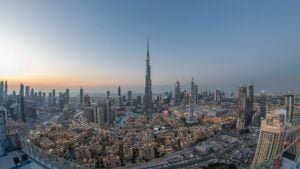

For months, discussions in the property world have centered around one big question — is Dubai’s real estate market heading for a correction in 2026? Analysts, casual investors, and market spectators are watching the numbers, waiting for signs of slowdown. Yet, the ultra‑wealthy — the top 1% — seem unfazed. They’re still pouring money into Dubai real estate investment opportunities, snapping up luxury villas, branded residences, and off‑plan properties across prime communities.
So, what do they see that others don’t? Why are the world’s most affluent investors doubling down when everyone else hesitates? Let’s break down the psychology, data, and global trends driving this elite confidence.
The Myth of the 2026 “Burst”
Every few years, predictions of a Dubai real estate “burst” resurface. The media cycle thrives on speculation, often comparing today’s market to previous cycles before 2008 or 2014. But the truth is: today’s fundamentals are stronger than ever.
- Government regulations have matured dramatically.
- Developers face tighter escrow and completion rules.
- Foreign ownership laws have opened the door for long‑term international investors.
- The city’s population continues to expand — with projections exceeding 6 million residents by the early 2030s.
Unlike speculative booms of the past, today’s growth is supported by infrastructure, diversified income, and policy stability. The 1% understands this. They see volatility not as a threat, but as a timing opportunity — a window to buy when fear dominates sentiment.
Dubai’s “Safe Haven” Status Keeps Growing
In a turbulent global landscape — from geopolitical tensions to inflationary pressures — Dubai has earned a rare title: the world’s most secure luxury investment hub.
For ultra‑high‑net‑worth individuals (UHNWIs), the city offers what many Western and Asian markets can’t right now:
- Zero property tax and no annual income tax.
- Currency stability, thanks to the dirham’s peg to the U.S. dollar.
- Effortless global connectivity, with Dubai International Airport serving 200+ destinations.
- Political neutrality and safety, attracting both investors and expatriates seeking long‑term stability.
Whenever global uncertainty rises, luxury capital tends to seek stability. Dubai, with its investor‑friendly policies and growing luxury ecosystem, becomes a natural magnet for high‑end real estate allocations.
Off‑Plan Gold: Why Developers Can’t Keep Up
Even as demand cools slightly for mid‑range apartments, premium and off‑plan properties at the luxury tier are still selling out within days. Projects in communities such as Palm Jumeirah, Dubai Hills Estate, and Business Bay continue to attract million‑dollar cheques before ground is even broken.
The 1% doesn’t buy off‑plan units for quick flips anymore. Instead, they treat them as wealth preservation tools — parking capital in tangible assets that appreciate while being protected by new regulatory controls.
Moreover, Dubai’s developers are aligning with global luxury brands — from Armani to Bugatti — creating exclusive demand that transcends local market cycles. A branded residence carries global status and scarcity value. When the supply is limited, the top 1% knows these assets age like fine wine.
A New Economic Vision Fuels Confidence
Dubai’s 2040 Urban Master Plan continues to serve as a long‑term assurance for investors. While smaller investors wait for a potential price correction, the elite are reading this blueprint differently — as proof of sustained growth and urban progress.
The plan promises:
- New economic hubs beyond Downtown and the Marina.
- Enhanced waterfront living districts.
- Expanded green and transit‑oriented zones.
- Continued diversification away from oil‑dependence.
Smart investors aren’t simply buying homes; they’re buying into an evolving metropolis poised for sustained relevance over the next two decades.
The Rental Boom Changes Everything
Dubai’s rental market has undergone a historic shift since 2021. The surge in high‑quality tenants — remote workers, entrepreneurs, and digital nomads — has transformed property yields.
The 1% is capitalizing on this income renaissance. Villas on Palm Jumeirah, penthouses in Downtown, and branded apartments in Business Bay now generate net rental yields between 6% and 9% annually — far outperforming global cities like London or Singapore.
To wealthy investors, real estate isn’t only about capital appreciation; it’s about cash flow resilience. And Dubai’s balance of high yield + luxury lifestyle + zero tax remains unmatched worldwide.
Lifestyle Capital: Where Wealth Meets Well‑Being
For global elites, ROI extends beyond money — it includes lifestyle, mobility, and citizenship options. Dubai masters all three.
From ultra‑luxurious resorts like Jumeirah Bay Island to climate‑controlled marinas and Michelin‑star dining, the city has redefined livable luxury. On top of that, the Golden Visa program has removed major barriers to long‑term residency, allowing investors and their families to stay without typical visa stress.
The 1% views Dubai not just as an investment zone, but as a permanent lifestyle anchor — safe, connected, tax‑efficient, and global.
A Truly International Buyer Pool
The composition of Dubai’s buyer market has diversified beyond recognition. It’s no longer dominated by Gulf Cooperation Council nationals — buyers now include Europeans, Chinese, Indians, Russians, and Africans looking to move assets into politically neutral jurisdictions.
This multicultural demand base acts as a natural stabilizer — ensuring that capital inflow continues even if one region slows down. Such international balance makes Dubai uniquely resilient against the kind of localized crashes seen elsewhere.
Why the 1% Plays by Different Rules
When everyday buyers hesitate, elite investors often accelerate. This counter‑cyclical behavior stems from several key factors:
- Capital Readiness. The 1% isn’t reliant on mortgages or high‑cost leverage. They have liquidity ready to deploy when opportunities arise.
- Time Horizon. They buy with 10‑ to 20‑year outlooks, not short‑term flip goals.
- Diversification Strategy. Real estate is only one asset class among global holdings — risk is spread horizontally.
- Emotional Detachment. They don’t chase hype or panic; they follow data and geopolitical foresight.
- Insider Access. Exclusive previews, developer partnerships, and personalized financing keep them ahead of public launches.
So, while everyone else waits for “the burst,” the elite are building positions that stand to grow steadily in both yield and prestige.
What If a Correction Comes?
Even if 2026 brings minor price cooling or resale slowdowns, the top 1% is still positioned to win. Why?
- They buy premium scarcity (limited plots, sea views, branded projects).
- They rarely need to sell — downturns simply mean better buy‑in opportunities.
- They invest in resilient zones where infrastructure and lifestyle lock value.
A temporary price dip, from their perspective, isn’t a risk. It’s a strategy.
Data Still Favors Long‑Term Growth
Recent figures show consistent year‑on‑year performance across Dubai’s property sector:
- Average price growth of 15–20% in prime areas since 2022.
- Continuous population increase — hitting 3.7 million in 2025.
- Ongoing foreign direct investment expansion into tourism, green tech, and logistics.
When economic activity expands faster than housing supply, it’s hard to imagine a deep correction. More importantly, the 1% recognizes that demand for physical space — from corporate HQ relocations to expat families — continues to outrun construction capacity.
The Smart Money’s Silent Message
Every luxury transaction tells a quiet story. When a $20 million villa sells in Jumeirah Bay while social media debates “the upcoming crash,” that’s a strong signal: smart money trusts fundamentals over narratives.
The wealthy aren’t immune to risk; they’re simply better at reading cycles. They know that Dubai’s combination of location, safety, and tax incentives forms a long‑term value base unmatched by any new global city.
For them, 2026 isn’t a threat. It’s just another checkpoint on Dubai’s evolution from an emerging luxury hub to a mature global powerhouse.
So, Should Everyday Investors Follow Their Lead?
You don’t have to be part of the 1% to learn from them. Their moves reveal key lessons:
- Think Long‑Term: Don’t chase quarterly gains. Dubai real estate investment rewards patience.
- Prioritize Location: Invest in areas tied to infrastructure growth — Business Bay, Dubai Creek Harbour, or Expo City.
- Study Policy Shifts: Keep an eye on updated visa rules, mortgage rates, and developer incentives.
- Diversify within Dubai: Consider a mix of off‑plan, resale, and rental‑yield assets.
Final Thoughts: Fear Waits, Wealth Moves
Markets always cycle through fear and optimism. Right now, the middle-class debates whether 2026 will bring a correction; the ultra‑wealthy are busy expanding portfolios.
The truth is, no one can predict the exact month or year of a slowdown — but one fact remains constant: Dubai real estate investment continues to outperform on fundamentals. As the world grows more uncertain, Dubai’s blend of innovation, safety, and profitability remains a rare constant that sophisticated investors will always value.
So while the crowd waits for the so‑called “burst,” the 1% quietly keeps buying — turning tomorrow’s uncertainty into today’s wealth.